
Written by Hassan Mazoz

Morocco packs an unusual amount into a country you can cross in a day of flying. In a single trip you can wander a thousand-year-old medina, drink mint tea in a mountain village, watch the Sahara turn from gold to rose at sunset and finish with sea air on the Atlantic ramparts. The hard part is not finding places worth visiting. It is deciding which ones deserve your limited days.
This guide covers 15 incredible places to visit in Morocco, grouped by region, with honest notes on how long each deserves and what makes it special. At the end you will find suggested Morocco itineraries that string the best places together at a comfortable pace, so you can see how they fit on the map before you book anything.
The short version
First visit with 7 to 10 days? Combine Marrakech, the Atlas crossing, Aït Benhaddou and a night in the Sahara at Merzouga, then add Fes or Essaouira. With 12 days or more, add Chefchaouen and the northern imperial cities for a full loop.
How to use this list
Morocco looks compact on a map, but the roads wind through mountain passes and the best landscapes are often a full day apart. As a rule of thumb, plan for no more than two or three hours of driving on a normal day, and leave room to stop. Rushing is the most common mistake first-time visitors make, and it is the one our private journeys are designed to avoid.
Each place below includes a suggested stay. Add them up and you will quickly see why a 5-day trip suits one theme (the desert, for example) while a 12 to 15 day trip can cover the highlights of Morocco.
Imperial cities and the north
1. Marrakech
Almost every journey begins or ends in Marrakech, and it earns the attention. The medina is a living maze of souks, tanneries, spice stalls and quiet courtyards, centred on the Jemaa el-Fna square, which changes character from morning juice stands to a crowded evening open-air kitchen. Add the Koutoubia minaret, the Saadian Tombs, the Bahia Palace and the calm of the Majorelle and Menara gardens, and you have a city that rewards slow wandering.
Suggested stay: 2 to 3 nights. Stay in a riad inside the medina for atmosphere, and book a local guide for the first morning to learn how the souks are organised.
2. Fes
Fes is Morocco’s oldest imperial city and its most authentic medieval one. Fes el-Bali is among the largest car-free urban areas in the world, and getting lost in it is part of the point. Look for the Al-Attarine and Bou Inania madrasas, the Chouara tannery viewed from a leather-shop terrace, and the University of al-Qarawiyyin, one of the oldest continually operating universities in the world. The food is also some of the best in the country.
Suggested stay: 2 nights, ideally with a guide. Fes is the city where local knowledge matters most.
3. Chefchaouen
Set in the Rif mountains, Chefchaouen is known for its blue-washed lanes and slow, relaxed pace. It is a welcome contrast after the intensity of Fes or Marrakech. Wander the medina in the early morning before day visitors arrive, climb to the Spanish Mosque viewpoint for sunset, and consider a half-day walk in the surrounding hills.
Suggested stay: 1 to 2 nights. It is a town for lingering, not ticking off.
4. Meknes and Volubilis
Often skipped, Meknes is a pleasure for exactly that reason. It has grand imperial gateways, the Bab Mansour gate and a medina that feels far less hurried than its neighbours. Nearby, the Roman ruins of Volubilis, with their mosaics and columns standing against open farmland, show the country’s layered history.
Suggested stay: a half day when travelling between Fes and Rabat, or a long lunch stop on the way.
5. Rabat
Morocco’s capital is calm, tidy and easy to enjoy. The Kasbah of the Udayas, the Hassan Tower, the Mausoleum of Mohammed V and the riverside medina make for a comfortable day of sightseeing without the crowds of Marrakech. It also sits neatly on the route between Casablanca and Fes.
Suggested stay: 1 night, or a long half-day stop.
6. Tangier
Tangier has always looked across the Strait of Gibraltar to Europe, and it shows in its mix of Moroccan, Spanish and international influence. The old medina, the cafés and the nearby Cap Spartel, where the Atlantic meets the Mediterranean, make it a good, gentle introduction to the country, especially if you are arriving from Spain.
Suggested stay: 1 night as a soft start before heading to Chefchaouen.
The Atlas, the kasbahs and the southern valleys
7. The High Atlas and Imlil
Within two hours of Marrakech, the High Atlas offers a completely different Morocco: terraced valleys, Amazigh villages and walnut groves beneath snow-capped peaks. Imlil, at the foot of Toubkal, is the usual base for gentle valley walks, a muleback ride or a mint-tea stop in a family home. You do not need to climb a summit to enjoy it.
Suggested stay: a day trip from Marrakech, or one night in a mountain guesthouse for a slower pace.
8. Aït Benhaddou
This fortified earthen village, a UNESCO World Heritage Site, is the best-known kasbah in the south and a familiar backdrop in many films. Cross the river at sunrise or late afternoon, when the light warms the clay walls, and climb to the top granary for views over the valley. Nearby Ouarzazate has a film-studio history and a handsome kasbah of its own at Taourirt.
Suggested stay: a stop of a few hours, or an overnight in a kasbah-style hotel nearby.
9. Dades Valley and Todra Gorge
Two of the south’s most dramatic landscapes sit close together. The Dades Valley is known for its rock formations and winding mountain road, while Todra Gorge narrows to limestone walls rising several hundred metres on either side of a small river. Both are best done on foot at an easy pace, with time for a long lunch under the date palms.
Suggested stay: 1 night, usually combined as part of the route to the Sahara.
10. The Draa Valley and Zagora
The Draa is Morocco’s longest river valley, a ribbon of palm groves and ochre villages running through otherwise dry country. It is a gentler and often quieter route to the desert, and it can be combined with an overnight camp near Zagora. If you want a shorter journey into the Sahara, the Draa route from Marrakech is the most practical. Our guide to desert tours from Marrakech compares Zagora and Merzouga in detail.
Suggested stay: 1 night, or 2 if you want time for a camel ride and the valley.
The Sahara
11. Merzouga and Erg Chebbi
This is the Sahara most people picture: tall, sculpted dunes that glow orange at sunrise and sunset. Merzouga is the gateway to Erg Chebbi, where you can ride a camel into the dunes at dusk, sleep in a desert camp and wake before dawn to watch the sun rise over the sand. Come with realistic expectations: it is a long drive from Marrakech or Fes, but the payoff is memorable.
Suggested stay: 1 night at least, 2 if you want a slower pace and a day to explore.
12. Erg Chegaga
For a wilder and quieter desert, Erg Chegaga offers vast dunes with far fewer visitors. It is reached by 4×4 across open plains from the Draa side, so it needs more time and planning, but the stillness at night, under a sky thick with stars, is hard to match. It suits travellers who want the desert itself rather than the closest dunes.
Suggested stay: 1 to 2 nights, with a private 4×4 and a driver who knows the terrain.
The Atlantic coast
13. Essaouira
Essaouira is a whitewashed, blue-shuttered port with a relaxed, artistic feel. Walk the 18th-century ramparts at sunset, browse the woodworkers’ shops, eat grilled fish at the harbour and enjoy the cooling sea breeze that keeps it comfortable even in summer. It pairs naturally with Marrakech, which is about three hours away.
Suggested stay: 1 to 2 nights. It is the best place in the country to simply slow down.
14. Casablanca
Casablanca is Morocco’s largest and most modern city, and most travellers pass through its airport. If you have a few spare hours, the Hassan II Mosque is the highlight: one of the largest in the world, set right on the Atlantic, and open to visitors on guided tours. The art deco downtown is also worth a short stroll.
Suggested stay: a half day, or a single night at the start or end of a longer trip.
15. Taghazout and the surf coast
North of Agadir, the fishing village of Taghazout and its neighbouring beaches offer surf, yoga and a laid-back seaside rhythm. If your trip is mostly cultural, a night or two here makes a restful end, with ocean views in place of medinas.
Suggested stay: 2 nights as a beach finish to a busy itinerary.
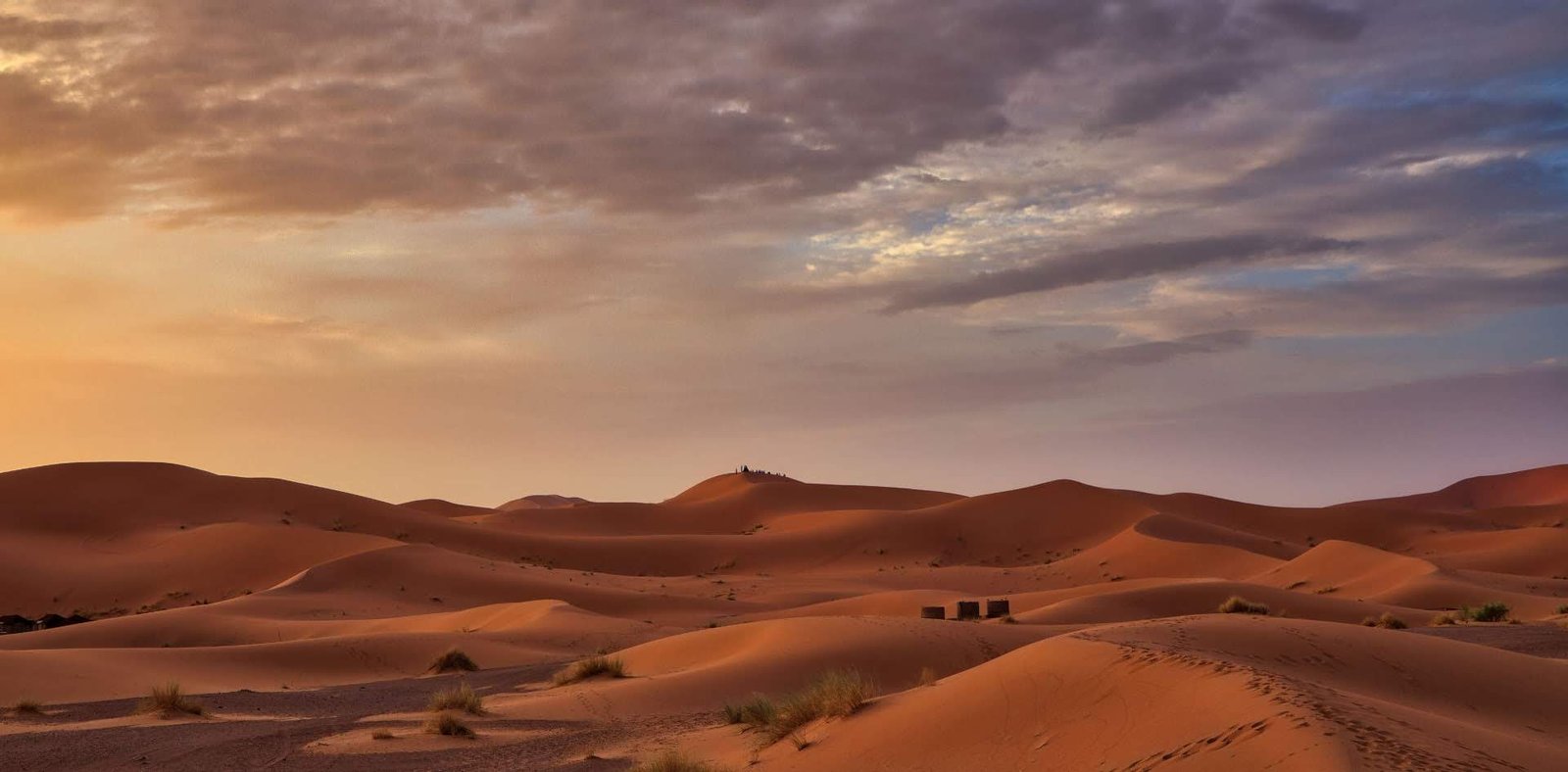
Sunrise over the dunes near Merzouga.
Suggested Morocco itineraries
These routes show how the places above combine. They are starting points, and every Morocco Unwind journey is private and can be reshaped around your dates and pace.
5 days: Marrakech and the Sahara via the Draa Valley
The best short trip for the desert. Start in Marrakech, cross the Atlas, follow the Draa Valley and spend a night in the dunes before returning. Perfect if you only have a long weekend and want a real taste of the south. See our 5-Day Marrakech Sahara Unwind Tour.
7 days: imperial cities and the Blue City
A northern loop that links Fes, Chefchaouen and the other imperial cities with unhurried days and plenty of time in the medinas. A good choice for travellers who care most about culture and architecture. See the 7-Day Imperial Cities and Blue City Unwind Tour.
8 days: the south and the coast
Combine the Atlas, the kasbahs, Erg Chegaga and the Atlantic coast for variety without a long drive each day. See the 8-Day Morocco Coast and Erg Chegaga Journey, or Morocco Uncovered for a classic eight-day route from Marrakech.
12 days: Tangier to Marrakech
A north-to-south crossing that takes in Tangier, Chefchaouen, Fes, the Sahara and Marrakech. It is the most complete way to see Morocco’s range, with enough days to keep the pace relaxed. See the 12-Day Tangier to Marrakech Comfort Unwind Journey.
15 days: the grand journey
For travellers who want it all: imperial cities, mountains, kasbahs, the desert and the coast, with rest days built in. See the 15-Day Comfort Grand Moroccan Journey.
Which places suit which traveller
Not every place on this list will suit every traveller, and that is fine. A few quick ways to narrow it down:
- If you love history and architecture: prioritise Fes, Meknes and Volubilis, Rabat and Marrakech. These are the places where the country’s imperial past is easiest to read in the buildings.
- If you want landscapes and space: choose the Atlas, the Dades Valley, Todra Gorge and the Sahara. Plan fewer cities and more time on the road.
- If you want to relax: build the trip around Essaouira, Chefchaouen and a riad in Marrakech with a pool. Slow mornings matter more than a long list of sights.
- If you travel with children or older parents: keep drives shorter, choose one base for two nights rather than a new hotel every day, and include a gentler desert option such as Zagora or a single dune night.
- If this is your first visit: pick one city, one mountain or valley stop and one night in the desert. You can always return for the rest.
Getting around Morocco
Morocco has a good network of trains between the big northern cities, including a fast service connecting Tangier, Rabat, Casablanca and Marrakech, but the most scenic places in the south and the Atlas are reached by road. Public transport in those regions is slow and infrequent, and self-driving means mountain passes, police checkpoints and unfamiliar road signs. For most travellers, a private driver is the most relaxed answer, because it lets you stop for photographs, a village market or a lunch you did not plan.
Plan for distance honestly. Marrakech to Merzouga, for example, is a long day even with stops, which is why most itineraries break the journey at a kasbah or in the Dades Valley. Fes to Merzouga also takes most of a day, and a well-designed route turns that drive into part of the experience rather than a chore.
What a day on a private journey looks like
People often ask what they will actually do each day. A typical day on one of our unhurried journeys starts with a late breakfast at the riad or hotel, followed by a drive or walk of a few hours, a long lunch with a view, and some time in the afternoon to rest or explore on your own. Evenings are for dinner at a restaurant your driver or guide recommends, or a home-cooked meal in a family kitchen. Nothing is rushed, and the route can change if you find a place you love and want to stay longer.
Common mistakes to avoid
- Trying to see everything. Fifteen places in seven days is a list, not a trip. Choose fewer places and enjoy them.
- Underestimating drive times. Add a buffer for mountain roads, tea stops and the occasional delay.
- Skipping the shoulder seasons. Spring and autumn offer the best balance of weather and crowds for combining cities and the desert.
- Booking the desert for a single rushed night after a very long drive. Build in a rest stop on the way and, where possible, give yourself two nights near the dunes.
- Leaving packing to the last minute. Bring layers: desert nights and Atlas mornings can be surprisingly cold, even in spring.
When to go
Spring (March to May) and autumn (September to November) are the most comfortable seasons for combining cities and the desert. Summer can be very hot in the south, though the coast and mountains stay cooler. Winter is mild in the cities and cold at night in the desert and the Atlas. Ramadan changes the rhythm of daily life, so check dates when planning.
Frequently asked questions
How many days do I need in Morocco?
Five days is enough for a single theme such as Marrakech and the desert. Seven to ten days suits a first visit combining cities and the Sahara. Twelve days or more lets you cover the north and south without rushing.
Is it better to travel privately or in a group?
Distances are long and the best places are spread out, so a private driver and guide make the experience far easier, especially for first-time visitors. Read more in our guide for first-time visitors.
Can I combine the desert and the coast in one trip?
Yes. Marrakech makes a natural hub: head south to the desert, then return via the Atlas and finish in Essaouira. Allow at least eight days for a relaxed pace.
Which places are best for a short trip?
Marrakech, the Atlas and a night in the Sahara give the most variety in five days. If the desert is less of a priority, Marrakech, Essaouira and the Atlas make a calmer alternative.
Respectful travel and practical tips
A little preparation goes a long way. Dress modestly in medinas and villages: shoulders and knees covered is a good rule, and light, loose clothing is comfortable in the heat. Ask before photographing people, and be prepared for polite but persistent offers in the souks. A friendly “no, thank you” and a smile is usually enough. Carry some cash in small notes for tips, tea and market purchases, since cards are not accepted everywhere, particularly outside the big cities.
Bring a refillable bottle and drink bottled or filtered water, protect yourself from the sun with a hat and sunscreen, and keep a light scarf handy for dust in the desert and for visiting some religious sites from the outside. Tipping is customary for guides, drivers and restaurant staff, and your tour operator can advise on what is appropriate in each situation.
Finally, build in unplanned time. The most memorable moments in Morocco are often the unscheduled ones: an invitation to tea, a side street you were not meant to find, a conversation with a craftsman in a workshop. A private journey with a flexible plan makes room for exactly that.
Do I need a visa for Morocco?
Entry requirements depend on your passport, so check the official guidance for your nationality well before you travel. Your tour operator can confirm what documents are needed once your dates are set.
Is Morocco safe for tourists?
Morocco is a well-established destination and most visitors travel without problems. Take the usual precautions with valuables in crowded areas, use licensed guides and drivers, and ask your hotel or operator if you are unsure about anything.
Plan your Morocco journey with us
Morocco is easier to enjoy when someone else handles the logistics: the drivers, the hotels, the timing and the quiet local knowledge that makes each place feel personal. Browse our Morocco tours, or tell us what you would like to see and we will design a route around you.
Explore our custom Morocco tours for first-time visitors
Prefer to talk it through first? Send us an enquiry and we will reply with ideas for your dates.