
Every week we get the same question from travellers flying into Spain: is it worth taking the ferry across to Morocco, and which one should I book? The answer is usually yes. The crossing over the Strait of Gibraltar is short, cheap and far more civilised than a flight, and it drops you into northern Morocco right where the good roads begin.
This guide covers the two crossings that matter, what each one costs, how the ports actually work on the day, and how to connect the ferry to a route through Morocco without losing half a day to confusion.
The short answer
There are two crossings worth considering. Tarifa to Tangier Ville takes about an hour and lands you in the centre of Tangier, which makes it the best choice on foot. Algeciras to Tanger Med takes around ninety minutes and puts you on the motorway about 40 km east of Tangier, which makes it the best choice with a car. Foot passenger fares start from around €10 to €11 one way in low season; a car with driver starts from roughly €165.

Tarifa to Tangier Ville: the one to take on foot
The crossing takes roughly an hour, and it is the shortest sea route between Europe and Africa. Two operators run it, Baleària and Africa Morocco Link, with several sailings a day in each direction. In low season a foot passenger pays from around €11 one way.
The reason to choose it is where you land. Tangier Ville sits in the city itself, which means you walk off the boat and you are effectively in Tangier. No shuttle, no taxi rank negotiation, no forty-kilometre transfer. If you are arriving by bus or train into Tarifa and continuing on foot, this route removes an entire layer of logistics from your arrival.
Tarifa itself is a small windsurfing town at the southern tip of Spain, and the ferry terminal is compact. The one thing to watch is wind: Tarifa is famous for it, and the fast ferries can be affected when it blows hard. Build a little slack into your plans rather than booking a same-day onward connection you cannot miss.
Algeciras to Tanger Med: the one to take with a car
Around ninety minutes, and the busiest route on the strait. Baleària, FRS, Africa Morocco Link and DFDS all sail it, with sailings running through the day and night. A car with driver starts from roughly €165 one way in low season, and foot passengers from about €10.
Tanger Med is a large modern port about 40 km east of Tangier, connected directly to the motorway network. That is exactly what you want if you are driving south towards Chefchaouen, Fes or the Rif: you clear the port and you are on a fast road heading the right way, rather than threading through a city centre first.
If you are travelling on foot and land at Tanger Med by mistake or by necessity, plan the transfer to Tangier in advance. The port is not walkable to the city, and arriving without a plan is the most common way people lose an afternoon on this crossing.

What the ferry costs
These are starting fares for one-way crossings in low season, taken from published 2026 fare tables. Treat them as a planning guide, not a quote: prices move with season, demand and how far ahead you book.
| Route | Crossing time | Foot passenger from | Car with driver from |
|---|---|---|---|
| Algeciras – Tanger Med | about 1.5 hours | €10 | €165 |
| Tarifa – Tangier Ville | about 1 hour | €11 | €179 |
| Algeciras – Ceuta | 1 to 1.5 hours | €34 | €122 |
| Almería – Nador | 7 to 8 hours | €71 | by vehicle length |
| Barcelona – Tanger Med | 30 to 35 hours | €93 | by vehicle length |
The vehicle is what makes the price move. Car fares are charged by the size of the vehicle, not by how many people are in it, so a standard car is the cheapest thing to bring and a motorhome or a van with a roof box costs more. Enter the dimensions accurately when you book, including anything bolted to the roof.
The other routes, and when they make sense
If you are already in eastern Andalusia, the crossings to Melilla and Nador save a long drive west. Melilla and Ceuta are Spanish cities on the North African coast, so you land on Spanish soil and cross into Morocco by land afterwards, which is a different process to arriving at a Moroccan port.
From France or Italy there are long crossings direct to Tanger Med: Barcelona takes roughly 30 to 35 hours, Sète around 42 to 49, Genoa around 50 to 57. They cost more and take days, but they replace a long drive through Spain, and they suit anyone travelling with a vehicle from further north in Europe. Note that the Marseille to Tanger Med route has been suspended for the low season since 15 September 2026, with no restart date published, so check before planning around it.
Opération Marhaba: the summer crunch
If you are crossing in July or August, know about this before you book. Every summer, Moroccans living across Europe travel home, and the ports handle enormous volumes in a matter of weeks. During that period the ports only admit passengers holding a ticket for a fixed date and departure time, and weekends plus the last week of August are the worst of it.
Practically, that means book both directions together and book early. Turning up hoping for a space in high summer is not a plan. Spring and autumn give you far more choice of sailings and considerably better fares.
On the day: passports, time zones and paperwork
Bring your passport, not a national ID card, and expect it to be checked at both ends. If you are driving, carry the vehicle registration document and check your insurance covers Morocco specifically; a standard European policy usually does not. If you are bringing a hire car across, confirm with the rental company in writing that cross-border travel is permitted, because many do not allow it.
Watch the clock. Spain and Morocco do not always keep the same time, and the difference shifts with the season. Check the departure time on your ticket rather than assuming, and check it again the day before you sail.
Arrive earlier than you would for a domestic ferry. Port formalities and passport control at both ends take time, and the check-in window closes before departure. Ninety minutes before sailing is a sensible minimum with a vehicle.
Connecting the ferry to a Morocco itinerary
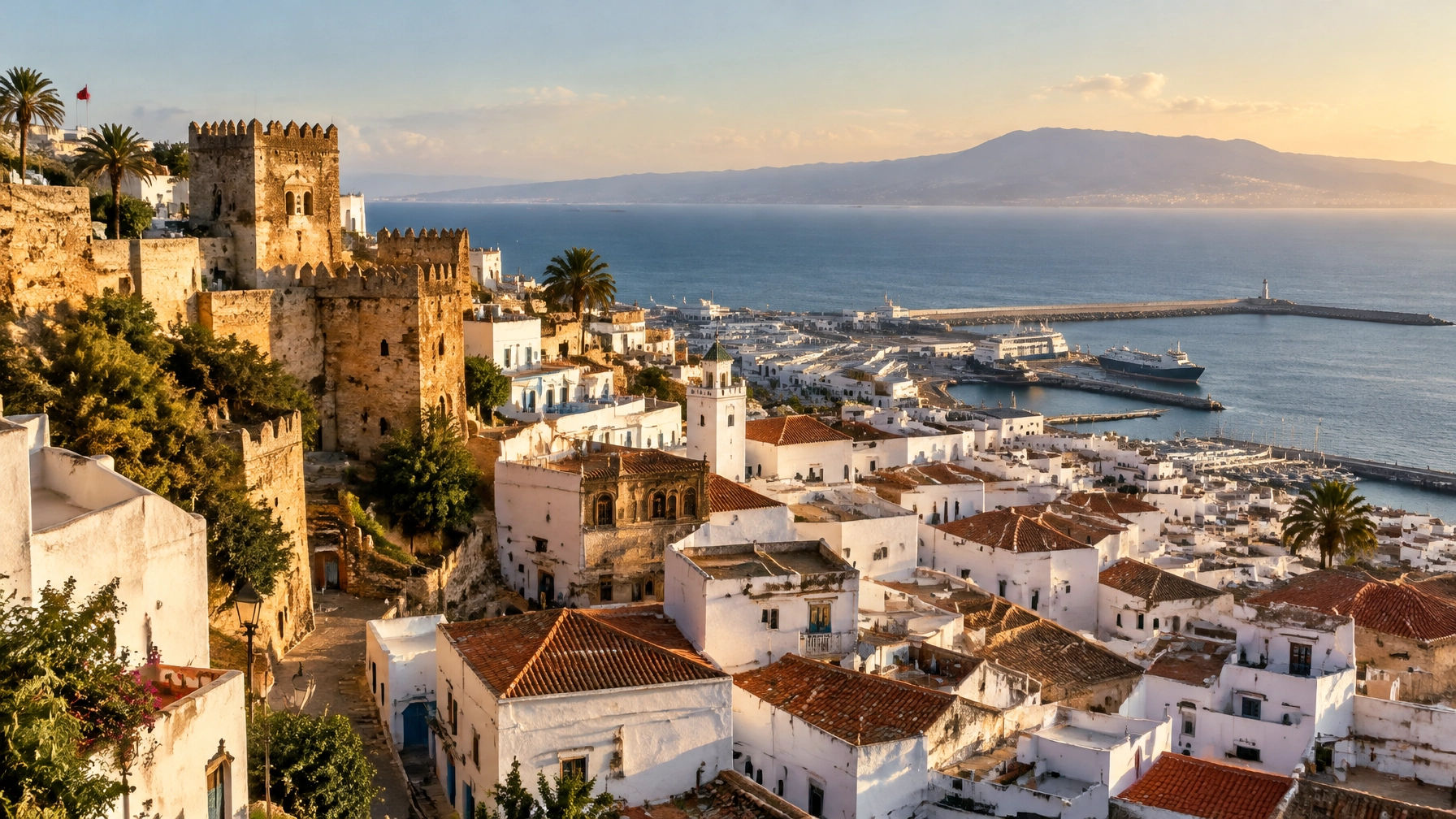
This is where the ferry genuinely pays off. Arriving in Tangier rather than flying into Marrakech or Casablanca puts you at the top of the country with the north in front of you: the Rif Mountains, Chefchaouen, Tetouan, then Volubilis and Fes. It is a far better shape for a first trip than landing in the south and driving north to come back again.
Our 12-Day Tangier to Marrakech journey is built around exactly this arrival. You start with Tangier and the Rif, spend two nights in Chefchaouen, continue through Volubilis and Fes, cross to the Sahara, and finish in Marrakech. No back-tracking, no wasted day.
If you have less time, the 7-day Imperial Cities and Blue City tour starts from Casablanca and includes the Tangier crossing point in its route. And if you are coming across specifically to see the north, our Fes and Chefchaouen Unwind tour pairs the two cities with Volubilis between them.
We meet guests at the port. Tell us which crossing you have booked and we will time the pickup around it, allowing for the formalities rather than guessing at them. Our guide to the Tangier to Chefchaouen to Fes route covers the driving stages once you are through.
Frequently asked questions
How long is the ferry from Spain to Morocco?
About one hour from Tarifa to Tangier Ville, and around ninety minutes from Algeciras to Tanger Med. The longer routes from Barcelona, Sète and Genoa take between thirty and fifty-seven hours.
Is Tarifa or Algeciras better for the ferry to Morocco?
Tarifa if you are travelling on foot, because it docks in central Tangier. Algeciras if you have a car, because Tanger Med connects straight to the motorway and has more sailings.
How much does the ferry to Morocco cost?
In low season, foot passengers pay from around €10 to €11 one way on the Strait crossings. A car with driver starts from roughly €165. Summer fares are higher, and vehicle size affects the car fare.
Do I need a car to take the ferry to Morocco?
No. Both main crossings carry foot passengers, and the short sea routes need no cabin. Travelling on foot is the cheaper option and works well if you are joining a private tour in Tangier.
Can I take a hire car from Spain to Morocco?
Only if the rental company allows cross-border travel, which many do not. Get written confirmation before you book, and check that your insurance covers Morocco.
What is Opération Marhaba and does it affect me?
It is the summer period when large numbers of Moroccans living in Europe travel home. Ports become very busy, tickets are tied to a fixed sailing, and weekends in July and August are the hardest. Book early and book both directions.
Can you do Morocco as a day trip from Spain?
Technically yes from Tarifa, and people do it. But a day trip gives you a few hours in Tangier and nothing beyond it. Two or three nights lets you see Chefchaouen and the Rif, which is where northern Morocco really starts.
If you are planning to arrive by ferry, tell us your crossing, your dates and how much time you have. We will build the route from the port onwards and send a tailored plan within 24 hours, by email or WhatsApp. You can also design your journey or browse all our Morocco tours.